Landlocked parcels and legal road access in Florida: easements explained
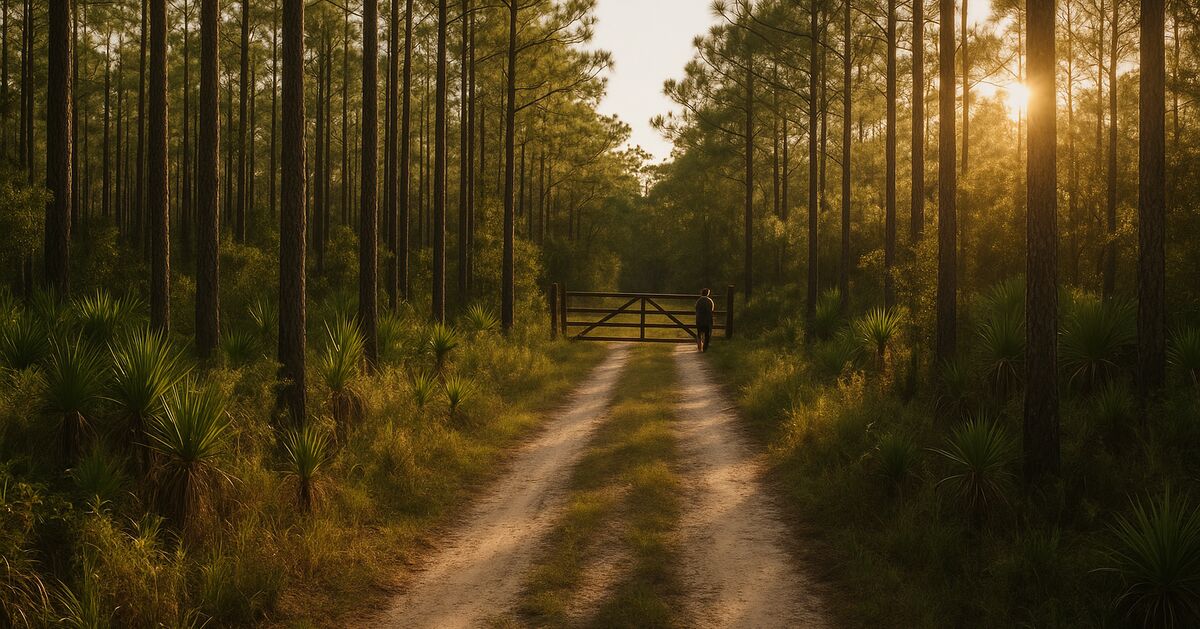
Buying a piece of Florida land only to discover you cannot legally drive to it is not a hypothetical nightmare - it happens, and it can turn a promising investment into an expensive legal problem that takes years to untangle.
Landlocked parcels are more common in rural Florida than many buyers expect. Old survey plats were sometimes recorded without reserving any road rights. Agricultural tracts were split off from larger farms with a handshake understanding about who could drive where. Heirs divided family land informally. The result is a patchwork of parcels whose only practical access depends on a neighbor's goodwill, a habit that has never been legally formalized, or - in the best case - a properly recorded easement that a title search will reveal. Understanding which situation applies before you hand over money is one of the most important steps in any vacant land due-diligence checklist for Florida buyers.
What "landlocked" actually means
A parcel is landlocked when it has no boundary that touches a publicly maintained road. The land itself is perfectly real, perfectly titled, and perfectly taxed - but without a legal right to cross someone else's property to reach it, the owner cannot build, farm, hunt, or do much of anything useful. Florida law recognizes this problem, but the remedies are not automatic and they are rarely free.
"Frontage" is the term used to describe a parcel boundary that abuts a public right-of-way. A county road, a state highway, or a dedicated subdivision street all qualify. A private road maintained by a homeowners association may qualify depending on the recorded plat. A dirt two-track worn through a neighbor's pasture does not qualify, no matter how long people have been driving on it.
The moment you see a parcel map where your target property is surrounded on all sides by other private parcels, you need to ask one question immediately: how does the owner legally get there?
The two main types of easements
Recorded (express) easements
A recorded easement is the gold standard. It is a written document - typically called an easement deed, a declaration of access easement, or a right-of-way grant - that has been signed by the grantor (the property owner who is giving up some rights), notarized, and recorded with the county clerk of courts. Because it is in the public record, it attaches to the land, not to a particular person. When the burdened parcel changes hands, the easement travels with both properties.
A well-drafted recorded easement will spell out:
- The exact width of the corridor (15 feet? 30 feet? 60 feet?)
- The permitted uses (foot traffic only, passenger vehicles, commercial trucks, utilities?)
- Who is responsible for maintenance and what standard of maintenance is required
- Whether the easement holder pays any portion of upkeep costs
- Whether the easement is exclusive or shared with others
- Any restrictions on hours, gates, or locked access
When you pull a title search or order title insurance, a recorded easement should appear in the chain of title. A title company will show it as an exception on the commitment. Read that exception carefully - it tells you exactly what rights you are and are not getting.
Prescriptive easements
A prescriptive easement is the legal equivalent of squatter's rights applied to a road. Florida courts recognize that when someone has openly, continuously, and adversely used a path across another person's land for a period of at least 20 years, a court may declare that they have earned a legal right to keep doing so. The doctrine comes from Florida's adverse possession statutes and common law.
The critical word is "may." A prescriptive easement does not exist until a court says it exists. Until that judgment is entered and recorded, you have a factual history of use and nothing more. That means:
- The neighbor can block the road the day after you close
- Lenders typically are reluctant to finance a purchase relying on prescriptive access.
- Title companies generally do not insure prescriptive access as a positive right, and instead flag it as a risk.
- If you want to build, a county building department will require proof of legal access before issuing a permit
A mistake that comes up repeatedly in owner forums is buyers accepting a seller's assurance that "everyone has always used that road" as though it were the same thing as a recorded easement. It is not. Use history is evidence that could support a future court claim. It is not a property right you can rely on today.
Easements by necessity
Florida courts also recognize easements by necessity under Florida Statute §704.01. When a parcel becomes landlocked as a result of a conveyance - meaning the original seller carved out a piece of land with no access and then retained the surrounding property - the law implies that a reasonable access route must exist. The landlocked owner can petition a court to establish that route.
The catch: you have to go to court. That means attorney fees, court costs, survey costs, and time. Outcomes are not guaranteed. The easement granted may be limited to the minimum width and use necessary to reach a public road, which might be a 10-foot path through a wet corner of the neighbor's property. It is a remedy, not a starting point.
What a title search will and will not tell you
A standard title search examines the chain of ownership and recorded documents in the county's official records. It will surface:
- Deeds, including any easement language written into older warranty deeds
- Separately recorded easement agreements
- Plat dedications that reserved road rights across the parcel or its neighbors
- Any judgments establishing easements by necessity that were recorded after a court order
What a title search will not surface is the physical reality on the ground. The recorded easement may describe a 30-foot corridor that has been entirely blocked by a fence for the past decade. The plat may dedicate a road that was never graded and sits under three feet of standing water. The recorded width may be legally sufficient for foot traffic but too narrow for a truck to turn around.
That is why a title search must be paired with a physical site visit and, when any doubt exists, a survey. Walk the route. Confirm it connects to a public road. Confirm the gate (if there is one) has a functional combination or that you will receive a key at closing. Confirm that no structure or fence has been built across the recorded corridor.
You can read more about the broader landscape of due-diligence steps - from flood maps to soil tests - on our frequently asked questions page and throughout the Vacant Florida Land blog.
Questions to ask the seller before you go under contract
A seller who has owned a landlocked parcel for any length of time should be able to answer these questions without hesitation. If they cannot, that tells you something important.
- Is there a recorded easement, and if so, can you provide the instrument number and book/page reference from the county records?
- Who owns the parcel or parcels that the access route crosses?
- Is there a gate? Who controls access to it?
- Has the access route ever been disputed or blocked?
- Has the parcel ever had a building permit issued on it, and if so, what access documentation was submitted to the county?
- Is the road maintained by anyone, or is it entirely informal?
- Has any survey been done that shows the easement corridor?
If the seller is offering owner financing - which is common with rural Florida vacant land - these questions are just as important as they would be in a cash sale. Owner financing does not change the legal reality of the property. For a plain-English explanation of how that financing structure works, see how owner-financed land works in Florida.
Questions to ask the title company
Your title company or real estate attorney is your most important resource for access issues. Before or shortly after going under contract, ask:
- Does the title commitment show any easements benefiting this parcel?
- Does the commitment show any easements burdening adjacent parcels that would provide our access?
- Is there any gap in the chain of title that could affect the validity of the access easement?
- Will the policy insure our right of access, or is access listed as an exception?
- Is there anything in the survey or plat that the policy will not cover?
Title insurance on vacant land is often less expensive than buyers expect, though costs vary by policy and insurer. Given that an access problem can render a parcel functionally worthless, declining title insurance on a landlocked or near-landlocked parcel is a risk that is very hard to justify.
The county's role: permits and subdivision rules
Florida counties play a more active role in access questions than many buyers realize. Many county building departments require applicants to demonstrate legal access to a public road before issuing a building permit, though requirements vary by county. Acceptable documentation often includes a recorded easement deed of adequate width or direct frontage on a county-maintained road, but specific requirements vary by county and should be confirmed locally.
Some counties also have subdivision regulations that govern when a parcel can be split. If a seller is offering you a freshly divided piece of a larger tract, ask whether the split was done through a formal platting process or a simple deed description. An informal split can create a landlocked parcel even when it was not the seller's intent.
The Florida Department of Transportation maintains the state highway system, and county road departments maintain county roads. Access onto either requires a driveway permit, and that permit will be denied if the parcel has no legal frontage on that road.
When a parcel without frontage might still be worth buying
Not every landlocked parcel is a bad deal. There are circumstances where limited or informal access is an acceptable trade-off:
- You are buying strictly for hunting, camping, or recreational use on a cash basis and have no plans to build or finance
- The seller already has a recorded easement in place with a reasonable width and maintenance terms
- The parcel connects to a navigable waterway with legal public access, and your intended use is water-based
- The price reflects the access limitation significantly - and you understand the cost and uncertainty of seeking a legal remedy later
In any of these cases, the risk is yours to take knowingly. The goal of this post is not to steer you away from landlocked parcels as a category; it is to make sure you are not surprised by access problems after closing, when fixing them is far more expensive and stressful than discovering them beforehand.
For a look at how other physical and regulatory factors layer on top of access - things like soil suitability for septic and well placement - the article on wells and septic on rural Florida land walks through what a soil test actually reveals and why it matters alongside the access question. And if the parcel you are evaluating sits in a low-lying area, do not skip the guidance on flood zones and wetlands on Florida vacant land - wetland buffering rules can effectively block a recorded easement corridor even when the document itself looks clean.
Putting it all together
Legal road access is not a technicality. It is the difference between owning land you can use and owning a rectangle on a map that you pay taxes on but can never reach. Florida law offers remedies for landlocked parcels, but those remedies are slow, uncertain, and costly. A recorded easement with clear terms, confirmed against a physical site visit and backed by a title insurance policy that covers your access rights - that is the target.
Before you sign anything on a parcel with no frontage on a public road, pull the county's property records and look for the easement instrument number. Search the clerk of courts database for that instrument. Read the document itself. Walk the route. Then ask your title company whether they will insure it.
That sequence - records, instrument, field, title - costs you a few hours and possibly a few hundred dollars. Discovering an access problem after closing can cost you years and tens of thousands. The calculus is straightforward.
If you are just getting started on evaluating Florida vacant land and want to understand the full picture of what ownership involves, the Florida land for sale buyer's guide is a good place to build that foundation before you dive into parcel-specific due diligence.
Sources & further reading
- Florida Statute §704.01 - Common-law and statutory easements (Florida Legislature)
- Florida Statute §704.04 - Petition for establishment of easement by necessity (Florida Legislature)
- Florida Statute §95.16 - Adverse possession with color of title (20-year prescriptive period context) (Florida Legislature)
- Official Records and Recording Requirements for Florida Documents (Florida Clerks of Court)
- ALTA/NSPS Land Title Survey Standards - Access and Easement Requirements (American Land Title Association (ALTA))
Revision history (1)
- Pre-publish editorial QA: clean; claim audit: 7 claims, 5 rewritten
Claim-by-claim audit (7 checked)
- “Florida courts recognize that when someone has openly, continuously, and adversely used a path across another person's land for a period of at least 20 years, a court may declare t…” (cited → flsenate.gov)
- “Florida courts also recognize easements by necessity under Florida Statute §704.01.” (cited → flsenate.gov)
- “Lenders typically are reluctant to finance a purchase relying on prescriptive access.” (rewritten to what the article can stand behind)
- “Title companies generally do not insure prescriptive access as a positive right, and instead flag it as a risk.” (rewritten to what the article can stand behind)
- “Many county building departments require applicants to demonstrate legal access to a public road before issuing a building permit, though requirements vary by county.” (rewritten to what the article can stand behind)
- “Acceptable documentation often includes a recorded easement deed of adequate width or direct frontage on a county-maintained road, but specific requirements vary by county and shou…” (rewritten to what the article can stand behind)
- “Title insurance on vacant land is often less expensive than buyers expect, though costs vary by policy and insurer.” (rewritten to what the article can stand behind)
Questions
Questions about a parcel?
Tell us which parcel you are looking at and what you want to know. A real person at Lotvestors LLC answers by email, usually within one business day.
We work by email, not by phone: it keeps a written record of every answer about a parcel.