Florida Land for Sale: A Plain-English Buyer's Guide
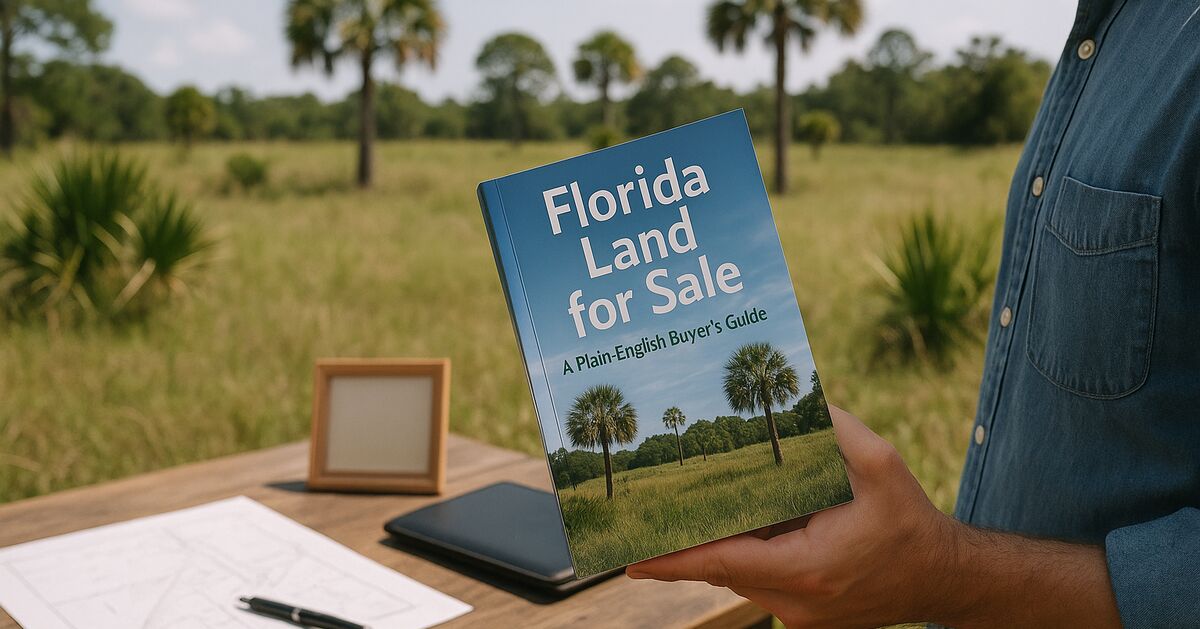
If you have typed "Florida land for sale" into a search box, you already know the problem. You get a wall of listings that range from $2,000 to $2 million, half of them with no photos of anything but pine trees, and no explanation of why one acre costs less than a used lawn mower while the acre next to it costs more than a house. This guide is our attempt to explain the market in plain English: where Florida land comes from, how to find it, what to check before you pay anyone, why cheap land is cheap, and what owner financing changes about the whole picture.
We are Lotvestors LLC. We have been buying and selling Florida land since 2015, we own every parcel we sell, and Sarasota is our home town. We sell mostly inexpensive buy-and-hold parcels with owner financing, so we have a point of view. We will try to keep it honest.
Where Florida land actually comes from
Most of the cheap vacant parcels you see online share the same origin story. Decades ago, developers bought huge tracts of rural Florida, drew lot lines on paper, filed a plat with the county, and sold the lots by mail to buyers all over the country. Some of those subdivisions were built out. Port Charlotte is the famous example: today it has roads, power, water, and a lot of houses.
Many others were never finished. The developer went broke or moved on, the roads were never cut, and the lots sat on the county tax roll for fifty years. The "streets" exist only as easements on a recorded plat. Names like Orlando Pines, Valhalla Acres, Gateway Acres and University Highlands are exactly this kind of place. The lots are real, the legal descriptions are real, the property taxes are real (and tiny), but there is nothing on the ground except scrub, pine and palmetto.
That is the supply side of cheap Florida land. It is not a scam and it is not a secret. It is leftover inventory from an earlier boom, and it changes hands between people who understand what it is and, sometimes, people who do not. Our job is to make sure you are in the first group before you buy from us.
How to find land for sale in Florida
There are five common channels, and each has a different flavor.
- The MLS and the big portals. Realtor-listed land. Usually higher priced, usually with better road access, often with a commission built in. Good for buildable lots in established neighborhoods.
- County tax deed and foreclosure auctions. Cheap, but you are bidding against professionals, paying cash on the spot, and getting no help.
- Land auction sites and classifieds. A mixed bag. Some honest sellers, some who list parcels they do not own.
- Direct-from-owner land companies. That is us and companies like us. We buy parcels from owners who want out, then resell them, often with financing. You are dealing with the actual owner of record.
- Driving around rural counties. Still works, still slow.
Our own inventory lives on the available land page. Every parcel there is owned by Lotvestors LLC and listed with its cash price, monthly payment, term, annual taxes, parcel number and GPS coordinates. Every one can be reserved online for $99 down plus a $199 document fee.
What to check before you pay anyone
Whoever you buy from, the checklist is the same. We wrote a much longer version of this on the blog, but here is the short form.
- Parcel number. Every Florida county has a Property Appraiser website. Type in the parcel number from the listing. You should see the owner of record, the acreage, the assessed value, the tax history and usually an aerial photo. If a seller cannot give you a parcel number, walk away.
- Zoning and land use. Call the county Planning and Zoning office and ask two questions: what is this parcel zoned, and could I get a building permit today? Do not take the seller's word for it, including ours.
- Access. Is there a maintained road, a dirt trail, a platted easement, or nothing? Many cheap parcels have legal access on paper and no physical access on the ground.
- Flood zone and wetlands. Check the FEMA flood map and the county's wetland layers. A lot of central Florida is wet for part of the year.
- Taxes, liens and code violations. The Tax Collector site shows what is owed. The Clerk of Court shows recorded liens. Code enforcement shows open violations.
- HOA. Rare on old investment acreage, common in newer subdivisions. Ask anyway.
If that sounds like work, it is about two hours of work, and it is the difference between buying land and buying a story about land.
Why cheap land is cheap
People ask us this in two tones of voice. One is suspicious: what is wrong with it? The other is hopeful: is this a hidden bargain? The honest answer is in the middle.
Land is cheap for concrete, boring reasons. No maintained road. No power at the lot. No water or sewer, so any future use means a well and a septic system. Zoning or platting that does not allow a house today. Wetlands on part of the parcel. A location that is rural right now. Any one of these knocks the price down; three or four of them together get you a parcel priced in the low thousands.
Cheap land is also cheap because the market for it is thin. A buildable lot in Port Charlotte has thousands of potential buyers. A one-acre lot in an unbuilt subdivision off Old Grade Road in Polk City has a few hundred, most of them investors. Fewer bidders, lower price.
And cheap land is sometimes cheap because the seller needed it to be. We buy from owners who inherited a lot they never wanted, who are tired of paying taxes on something they have never seen, or who simply want cash now. We pay them, quickly, and we price the parcel to sell to you. We wrote a whole page about the "useless land" argument, Is this useless land?, if you want the long version. The short version: cheap is a description, not a verdict. It tells you what the land is not good for today. It does not tell you what it will be worth in fifteen years, and neither can we.
What owner financing changes
A bank will not lend you $5,000 to buy an unbuildable acre in Polk County. It is not worth their paperwork. So for most of this inventory, the choice is cash or owner financing.
Owner financing means we are the lender. Here is what that changes in practice:
- Approval. There is no credit check and no employment verification. If you can afford the payment without hardship, you are approved. That is the entire underwriting process.
- Entry cost. $99 down plus a $199 document fee, $298 total, reserves the parcel. That is the number whether the cash price is $4,999 or $14,999.
- Cost of money. We charge 16% interest. That is high compared with a mortgage and low compared with a credit card, and we say so on every page. There is no prepayment penalty, so every extra dollar you pay cuts the interest.
- Ownership. We use a Contract for Deed. The parcel stays in our company name while you pay, and the deed is drawn up in your name when the balance hits zero. Until then you are a buyer under contract, not the owner of record.
- Rules. During the contract you cannot live on the land, alter it, clear it, fence it, store anything on it, or record the contract. These rules exist because earlier buyers did exactly those things and left us holding the fines. They are spelled out on the owner financing page and in the contract you sign.
Financing does not change the land. It changes who can buy it and how fast. That is the honest pitch.
Who this is for, and who it is not for
Our parcels are for people who want to own a piece of Florida for a low monthly amount, who understand that most of them are not buildable today, and who are comfortable holding for years. They are for the "buy land and wait" crowd.
They are not for someone who needs a place to park an RV next month, build a cabin next year, or flip the lot in six months. If that is you, you want a buildable lot with road frontage and power at the street, and you should expect to pay a lot more for it. We sometimes have those. Most of the time we do not, and we will tell you which is which.
The part where we talk about risk
Land can go down in value. Florida has had land busts before and will have them again. A parcel that is not buildable today may never be buildable. A parcel with no physical access may never get any. Property taxes, while small, are due every year. If you stop paying under a Contract for Deed, you lose the parcel and every payment you have made, because all payments are non-refundable. Nothing we say about future value is a guarantee; it is our opinion, offered as a courtesy. We tell you everything we know about each parcel, and we still expect you to verify it with the county yourself. Anyone who tells you land has no downside is selling something other than land.
What to do next
Look at the available parcels. Pick one that fits your budget. Pull its parcel number on the county Property Appraiser site. Call Planning and Zoning. Read the how it works page and the FAQ. Then, if it still makes sense, reserve it for $298 and sign the contract when it lands in your inbox. If you get stuck at any step, use the contact form. We would rather answer a question before you buy than after.
Questions
Questions about a parcel?
Tell us which parcel you are looking at and what you want to know. A real person at Lotvestors LLC answers by email, usually within one business day.
We work by email, not by phone: it keeps a written record of every answer about a parcel.