A guide from Lotvestors LLC
Land banking in Florida, explained for people starting with $99
Land banking means buying inexpensive land in the path of growth and holding it, sometimes for decades, until someone needs it more than you do. Here is how it works, what it costs to hold, how people get out, and how they lose money.
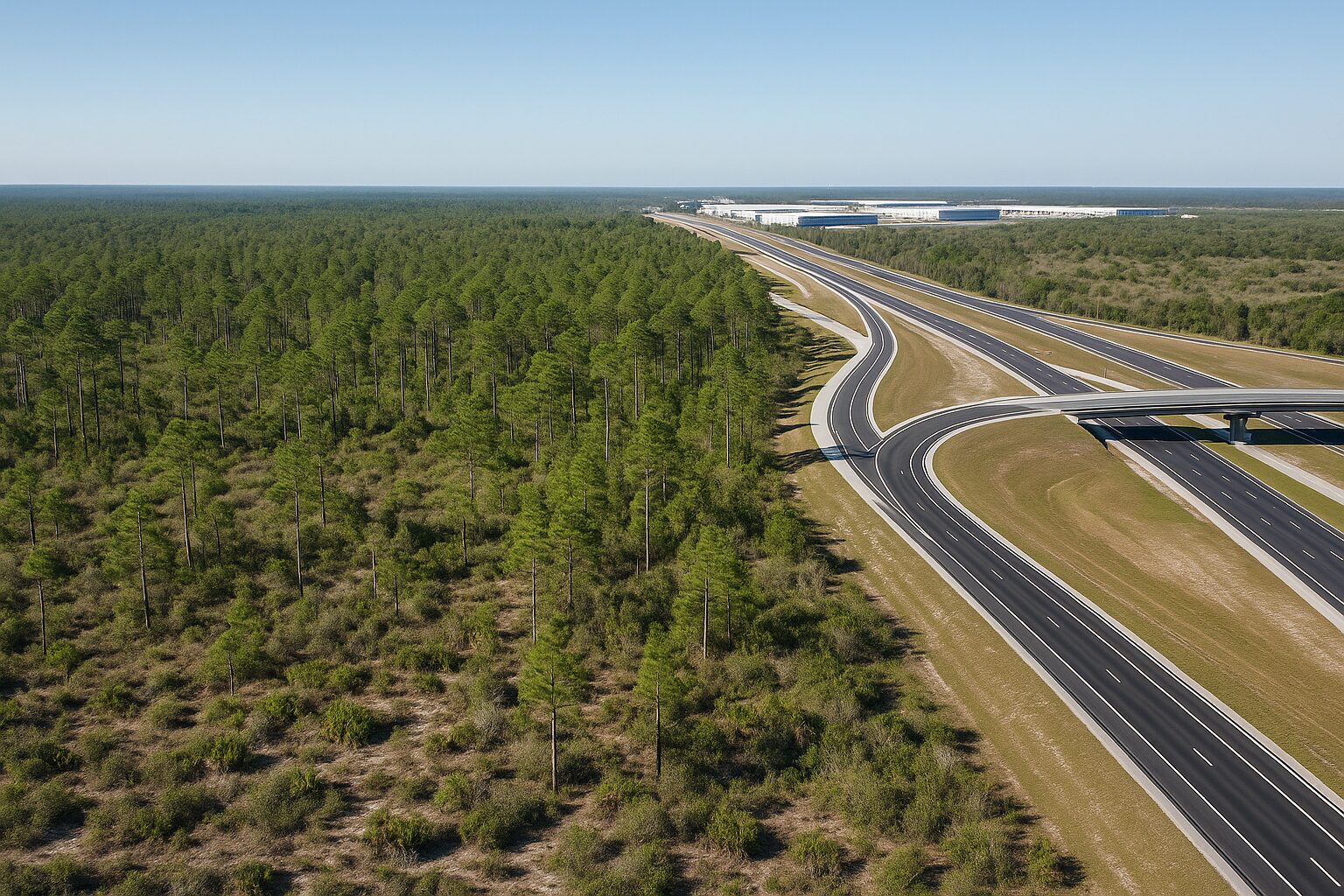
Land banking means buying inexpensive land and holding it, unused, until the area grows around it. In Florida it works because raw parcels in platted-but-unbuilt subdivisions can be bought for a few thousand dollars, with owner financing from $99 down, and cost as little as $8 to $30 a year in property tax to hold. Nothing is guaranteed: land can fall in value, most of these parcels cannot be built on today, and every fact should be checked with the county before you pay.
What land banking is
Land banking is buying raw land and holding it. That is the whole strategy. You are not building on it, renting it, farming it, or flipping it next spring. You are parking money in a piece of the earth that costs almost nothing to keep, in a place where more people and more businesses keep showing up, and waiting for the day the land is worth more to someone else than it is to you.
Developers do this at scale. They buy hundreds of acres on the edge of a metro area years before they intend to build anything, because land on the edge is cheap and land in the middle is not, and the edge keeps moving. A first-time buyer with a few hundred dollars cannot buy a hundred acres, but the same logic works on one acre. Roughly a thousand people a day move to Florida. They need houses, warehouses, roads, and somewhere to buy groceries. All of that goes on land that is currently sitting empty.
The trade you are making is time for price. Land that is buildable, on a paved road, with power and water at the lot, costs what it costs because it is ready today. Land that is not ready costs a fraction of that. The land banker buys the second kind and lets the calendar do the work.
Why raw land with low taxes is easy to hold
The thing that kills most long-term investments is the cost of carrying them. A rental house has a roof, a tenant, insurance, and a mortgage. A stock portfolio has your nerves. Raw land in a rural Florida subdivision has a property tax bill and nothing else. No insurance is required. No maintenance. Nothing to break, nothing to leak, nobody calling you at 2 a.m.
The tax bill is the part people underestimate. Here are real numbers from parcels we offer or have sold:
- A 2.5 acre tract in DeLeon Springs, Volusia County: $27.82 a year.
- A 4.47 acre tract in Valhalla Acres, Polk City: $29.31 a year.
- A 1.25 acre lot in Groveland Ranch Acres, Polk County: $8.17 a year.
- A 1.25 acre lot in University Highlands, DeLand: $13.22 a year.
- Ten separate one-acre lots in Orlando Pines, Polk City: $65.50 a year for all ten.
Compare that with a buildable quarter-acre lot in Port Charlotte we once sold, which ran $363.12 a year. The buildable lot is a fine thing to own if you plan to build. As a pure hold, it costs about twelve times as much to sit on.
The holding-cost math
Take the DeLeon Springs parcel as an example. Cash price $4,999. Say you finance it at $119.16 a month for five years, then hold it. That is about $7,150 in payments plus the $298 to reserve. Once it is paid off, your annual cost of ownership is $27.82. Hold it fifteen more years and you have spent about $417 in taxes over that stretch. Call it $7,900 all in, over twenty years.
Now look at that squarely. If the land never appreciates a dime, you have lost about $33 a month for twenty years. That is the downside, and you should be comfortable with it before you buy. The upside is that you are not bleeding money every month while you wait, and you do not need a spectacular outcome for the numbers to work.
How the path of growth works
Florida does not grow evenly. It grows along the roads. Interstate 4 between Tampa and Orlando is the clearest example in the state: two major metros, one corridor, and everything in between filling in with distribution centers, subdivisions, and truck stops. Where a highway meets a state road, warehouses show up first because trucks need to get on and off. Near the I-4 and US 27 interchange in Polk County, there is now an Amazon fulfillment center, a FedEx facility, and a Walmart distribution center. The acre lots we sell in Orlando Pines sit a short distance from that interchange with no roads built and no power run, at prices that reflect exactly that.
The subdivisions that were platted and never built
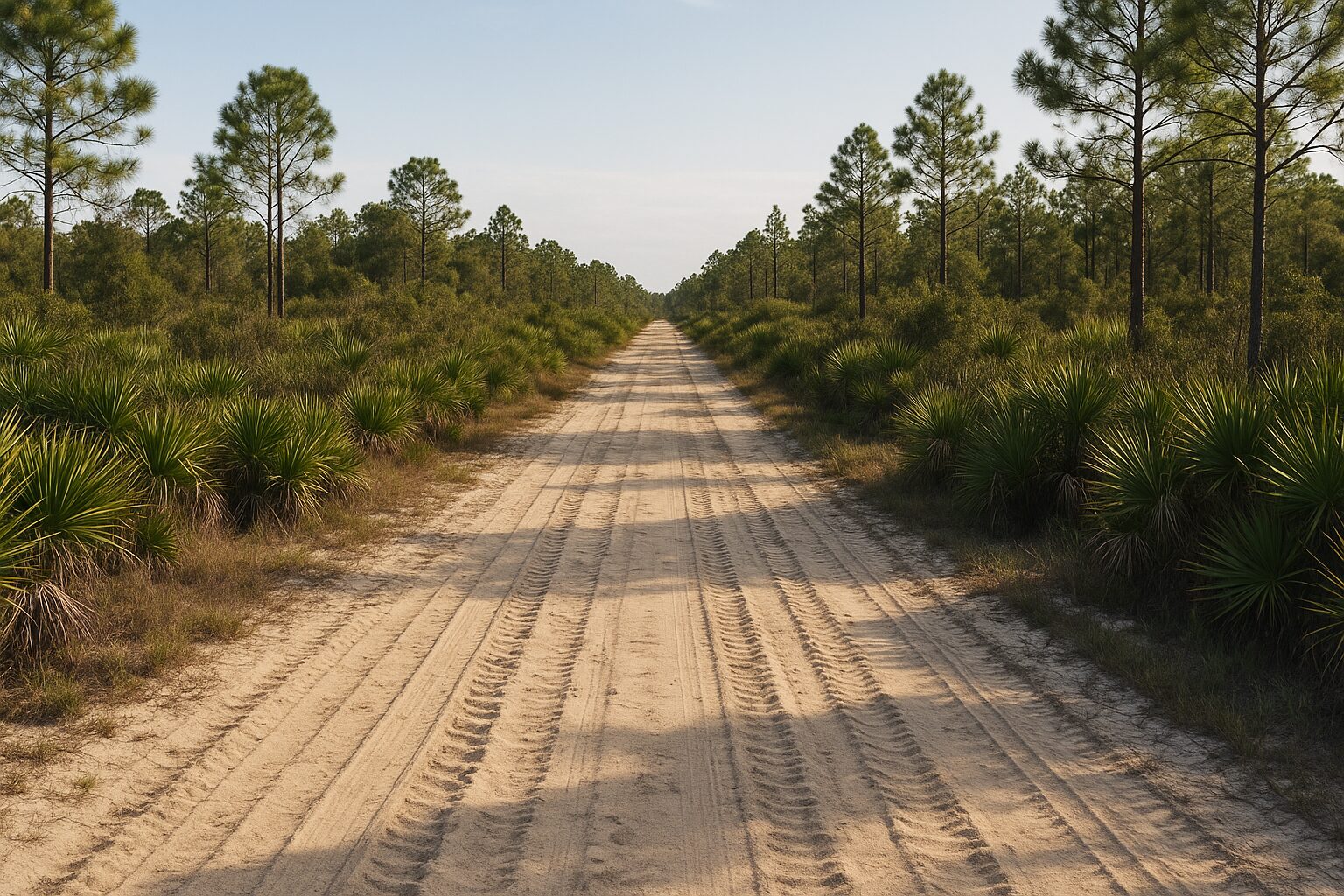
A lot of Florida's cheapest land sits inside subdivisions that were drawn on paper decades ago, sold as lots to buyers all over the country, and never built out. Orlando Pines, Valhalla Acres, Gateway Acres, University Highlands, Groveland Ranch Acres: the names are on the plat maps and the lot lines are recorded, but the roads were never paved and in many cases never cut. The original University Highlands brochure said it plainly: the low price was possible only because the land had no roads, drainage, or other improvements, and none were planned.
Those lots have been passed down, lost to tax sales, and bought and sold for decades. Most are still empty. The bet a land banker makes is that when growth reaches that area, a developer, a county, or an industrial user will want to assemble a large block and will pay to buy out the lot owners. In our opinion that is the most likely eventual outcome for something like Orlando Pines, not a street of single-family homes. It is not guaranteed, and nobody can tell you when.
Disney and the swamp
The oldest version of this story is Walt Disney quietly buying up acres of swamp in the middle of Florida to build Walt Disney World "in the middle of nowhere." The people who sold thought they were unloading useless land. For their own purposes, they were right; none of them was going to build a theme park. The point is that "useless to me" and "useless to everyone" are different things, and the second one is rare. We wrote a whole essay on this called Is This Useless Land?
Realistic exit strategies
Land banking only pays when you sell, so think about the exit before you buy. The realistic options:
- Sell to a neighbor. The person who owns the adjoining lot often wants yours, especially in a subdivision where putting two or three lots together makes something more usable. This is the most common small-parcel exit.
- Sell to a builder or developer. When growth arrives, someone wants to assemble a block. You get a letter. You do not have to accept the first offer.
- Sell it owner-financed yourself. You are learning this model as a buyer. Once you hold the deed, you can sell the same way we do: small down payment, monthly payments, interest. Your buyer pool is everyone a bank will not lend to, which is a lot of people.
- Sell for cash to another investor. Land investors buy from each other all the time. Expect a discount for speed.
- Hold for family. Land does not expire. Some buyers are putting away an acre for a kid or a grandkid with no intention of ever selling.
How people lose money
We would rather you know this now. Land can lose value, and it can sit unsold for years. The most common ways buyers get hurt:
- Paying too much. The math above only works at low prices. A $5,000 parcel that goes nowhere costs you $5,000 plus a little interest. A $50,000 parcel that goes nowhere is a real problem.
- Buying wetlands without knowing. A lot of cheap Florida land is wet for some or all of the year. Wet land can still end up in the path of growth (the Whole Foods in our home town of Sarasota sits on what was 100% wetlands), but it may never be buildable, and you should know what you are buying. Look at the FEMA flood map and the county GIS before you pay.
- Expecting to build. If your plan requires a house, a mobile home, or an RV pad, you are not land banking, you are buying a homesite, and you need a different parcel with road access, power, and zoning that allows it. Our Investment Acreage parcels are not that.
- Ignoring HOA dues or code liens. Some subdivisions have an active association with annual dues. Some lots carry old code enforcement liens for trash or mowing. Check the county records. Every listing on this site says whether there is an HOA.
- Forgetting the taxes. Thirty dollars a year is easy to forget three years in a row. Unpaid taxes become a tax certificate and eventually a tax deed sale, and the land is gone. While you are paying us, we pay the taxes and invoice you, so this cannot happen. After payoff, put it on a calendar.
- Assuming access. Legal access (a recorded easement or right of way) and physical access (a road you can drive on) are different things. Many of our parcels have the first and not the second. If you cannot get to it, that is fine for a hold and useless for a campsite.
Why owner financing changes who can do this
Historically, land banking was for people with cash to spare. Nobody finances a $5,000 lot; a bank will not touch it. That left the strategy to people who could write a check and forget about it. Owner financing changes the entry point. You reserve a parcel for $99 down and a $199 document fee, no credit check, and pay it off at a fixed monthly amount over three to nine years. The interest is 16%, which is real money, and there is no prepayment penalty, so pay it down as fast as you can. Everything about the contract, the tax invoice, the late fee, and what happens if you stop paying is on that page. Read it before you reserve anything.
How to start
- Decide what you can pay each month without noticing it. That is your budget, not a dollar more.
- Read how buying from us works and the owner financing page.
- Look at the available parcels. Every listing has the cash price, the monthly payment, the term, the parcel number, GPS coordinates, and the current annual tax.
- Pull up the parcel on the county property appraiser's site using the parcel number. Look at the aerial. Look at the flood map. Call Planning and Zoning if you have any use in mind beyond holding.
- Reserve it, pay the $298 invoice within 24 hours, and sign the contract within seven days. Make the payments.
- Then do the hard part: nothing. Do not wait to buy land. Buy land and wait.
The short version
- Buy cheap land with very low taxes.
- Hold it. Do not build, camp, or store on it during the contract.
- Sell, keep, or pass it on when the area catches up.
- Nothing is guaranteed; check everything with the county first.
Questions about holding raw land
- Can I build, camp, or park an RV on the parcel?
- Not during the contract. While you are making payments, you cannot live on the land, place a mobile home or RV, build anything, clear, fence, or store items there. After the parcel is paid off and deeded to you, what you can do is up to county zoning and land use rules, and most of our investment acreage is not buildable at this time. If building or camping is your goal, call the county Planning and Zoning office about the specific parcel number before you reserve it.
- What does not buildable at this time mean?
- It means that, as far as we know, the county will not issue a permit to build a home on the parcel today, usually because there is no constructed road, no utilities, or the area was never developed. Our Investment Acreage Program parcels are sold for buy-and-hold investment on exactly that basis. Whether a parcel ever becomes buildable depends on future development, county decisions and infrastructure that may or may not arrive. We cannot predict that, and we do not promise it.
- What does road access: easements mean?
- It means the parcel has legal access on paper but not a constructed road on the ground. In the old platted subdivisions where many of our parcels sit, the developer recorded 25 or 30 foot wide rights of way between the lots. Those easements guarantee that a road could legally be built someday and that you are not landlocked in the legal sense. They do not mean you can drive to the parcel today. Treat easements as an investment feature, not a driveway.
- What if the parcel is in a flood zone or has wetlands?
- It might. A lot of central Florida is low and wet for part of the year, and some of our parcels are in mapped flood zones or contain wetlands. We tell you everything we know on the listing, but we have not walked most of these parcels and we are not surveyors. Before you reserve, check the FEMA Flood Map Service Center for the flood zone and ask the county about wetland designations. For a buy-and-hold investment this may not matter to you. For any future use, it will.
- Can I use the property while I am making payments?
- Mostly no. To keep our risk and liability low enough to offer owner financing at these prices, the contract includes these rules while you are paying:
- You will not live on the property or let anyone else live on it.
- You will not alter the property without our written consent, including clearing it, adding structures or fences, or leaving items on it.
- You will comply with all building, zoning, health and other applicable codes.
- Any cost to correct a violation, including cleanup, fines and permits, is yours.
- You will not record the contract in any public records.
- Breaking any of these rules puts you immediately in default. - Can I buy more than one parcel?
- Yes. Many of our buyers own several parcels, and we have sold multi-lot packages in the past. Each parcel is reserved separately with its own $99 down payment and $199 document fee, and each gets its own Contract for Deed and monthly payment. If you are considering several lots at once, contact us first. We can tell you whether any adjoin, whether we have similar inventory not yet listed, and whether a package makes sense. Please make sure the combined monthly payments fit your budget.
Questions
Something on this page still unclear?
Ask it through the form and we will answer in writing, usually within one business day. Name the parcel you have in mind if there is one.
Written answers are easier to keep and compare than a phone call, which is one reason we do not take sales calls.