An essay from Lotvestors LLC
Is This Useless Land?
We hear this question more than any other, usually from someone who has just learned a parcel cannot have a house on it. Here is our honest answer, and a way of thinking about land that most people were never taught.
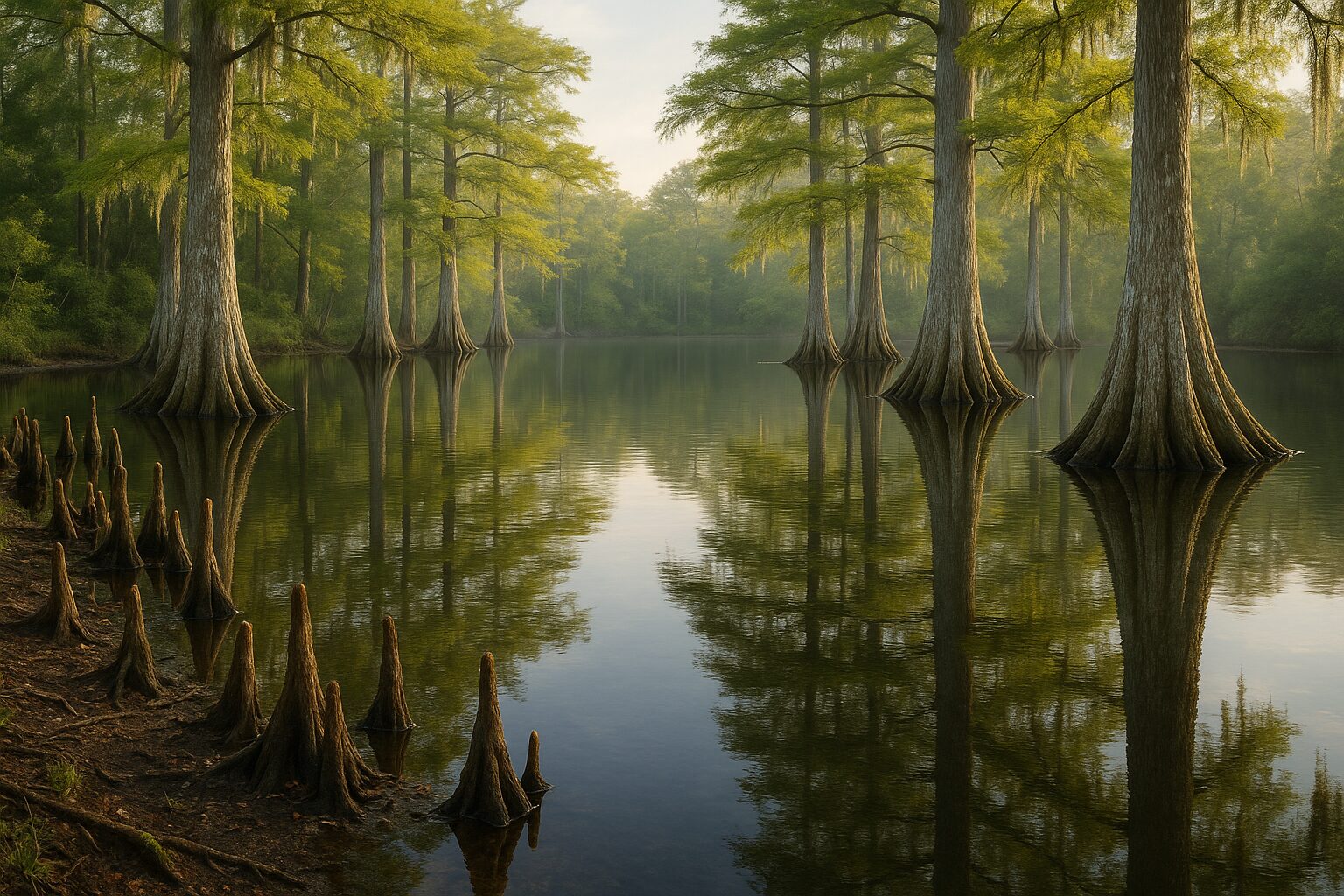
Short answer: land people call useless is usually land you cannot build on or drive to today. That is exactly why it is cheap, and why it can make sense as a buy-and-hold investment when it sits in the path of growth and costs under $30 a year in taxes to keep. It is not for camping, storage, or a cabin, and its future value is an opinion, not a promise.
This is not the first time we have heard someone use the term "useless land". Or that certain types of land are a "scam". 100% of the time it is from someone who is still in a "consumer mentality" and has not yet progressed into an "investor mentality".
If your idea of "useless land" is any kind of land that you cannot immediately build a house on or put a mobile home or RV on, then it is not because the land is useless, it is because you just do not understand land investing.
People who understand land investing know that raw land that happens to be in the path of growth, and/or in a state where people are moving to (there are over 1,000 people a DAY moving to Florida), is where fortunes have been made, by buying and holding land that uninformed people called "useless".
Besides the old story of Walt Disney quietly buying up acres of swamp in the middle of Florida to create Walt Disney World "in the middle of nowhere", there are many more recent examples all across the state.
For example, right near where we sell "useless" land in Polk County, there now sits an Amazon fulfillment center, a FedEx facility, a Walmart distribution center and more.
In our home town of Sarasota, there was a parcel that was 100% wetlands that Whole Foods wanted to build on. There was initially pushback by environmentalists (who were probably torn between wanting to save the swamp and having a place to buy their organic tofu), but eventually Whole Foods won. Now it is a Whole Foods, a Wawa and several shops and restaurants. Not so useless any more.
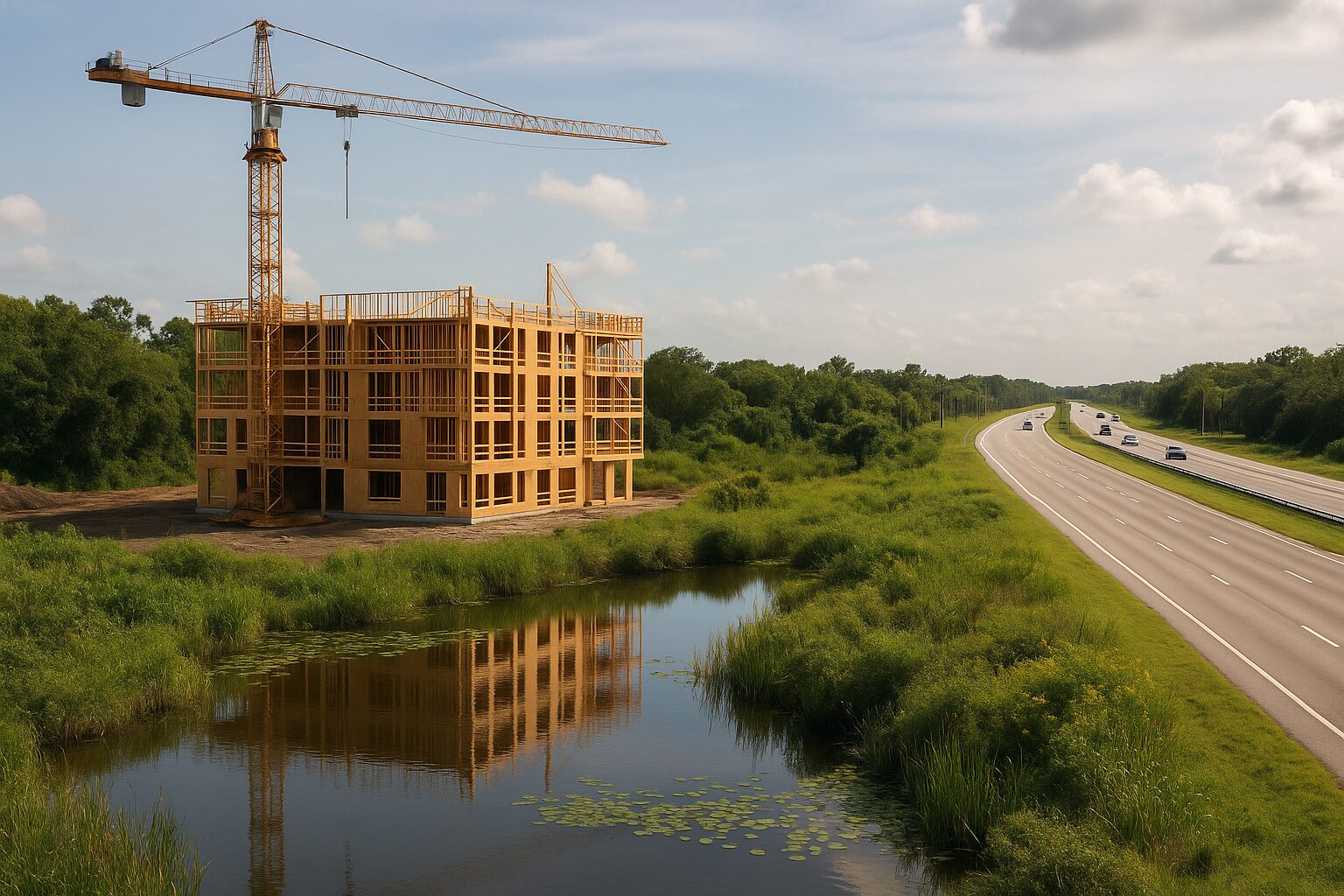
Another example is a wetland area that was right alongside a very busy and noisy section of I-75. Stand there long enough and you will have a headache from the noise and feel sick from breathing in all the truck exhaust. Well, the wetlands have been dried out by the construction of ponds and a huge "luxury" apartment complex is being built on the site.
There is a Starbucks on University Parkway in Sarasota. A couple of years ago we would sit in their outside area, right next to a swampy parcel. There was a sign on that parcel facing the sitting area that said "Conservation Area". Several months went by when we had not been by there. We drove by and saw a large swath of the "Conservation Area" was being bulldozed. A few months after that it was a new Chick-fil-A. The "Conservation Area" sign has now been moved to the other side of the Chick-fil-A property. We recently noticed that there is land clearing equipment being used in the Conservation Area. We wonder what will go there?
Please note: We are NOT condoning runaway development and we do not like the idea of natural habitat being destroyed. But, the reality is that Florida is booming and, regardless of whatever recessions may hit the rest of the country, Florida will, in our opinion, continue to grow. That means that "useless land" that can be bought now, especially with a low down payment and low monthly payments, could very well end up MUCH more profitable than "good land" that people without vision will buy.
Buying land as a place to build a home, or put a mobile home or RV on, or to use as recreation is fine, but that does not mean anything else is a scam! All you need is a little bit of education, open eyes and an open mind. Unfortunately, that is rare these days.
What "useless" actually means to an investor
Every piece of land has three kinds of value, and only one of them is visible to a consumer. There is use value: what you can do on it today. There is income value: what it pays you while you hold it. And there is future value: what it could become, and what someone else will pay for that.
A house lot on a paved road has use value, and you pay retail for it. A rental has income value. Raw acreage in a subdivision that was platted sixty years ago and never got its roads has neither. What it has is future value and almost nothing else, which is exactly why it is cheap. The consumer looks at the first two, sees a pair of zeros, and stops reading. The investor skips to the third and asks two questions: what does it cost me to hold this, and what would have to happen for it to be worth more? When the answer to the first is a tax bill under $30 a year and the answer to the second is "the thing that is already happening ten miles down the interstate," the word "useless" starts to look like a description of the buyer's plans rather than the land.
The questions to ask before you call land useless
Not every cheap parcel is a good buy. You just have to ask better questions than "can I put a house on it." Here are the ones we would ask:
- Access. Is there legal access (a recorded easement or right of way), and is there physical access (a road you can actually drive)? They are different things. Most of our investment parcels have the first and not the second. That is fine for a hold and no good for a campsite.
- Wetlands. Pull up the county GIS and the FEMA flood map. Wet land can still be in the path of growth, as every Sarasota example above shows, but you should know what you are buying, and you should assume it will not be buildable in your lifetime.
- Zoning and future land use. Call the county Planning and Zoning office with the parcel number. Ask what is allowed today and what the future land use map says. Their answer is the only one that counts. Ours does not.
- Taxes. Look up the tax history on the property appraiser's site. The annual tax is your entire holding cost. If it is $30, you can hold for as long as you like. If it is $3,000, you need a plan.
- Liens and dues. Is there an active homeowners association? Are there old code enforcement liens? Both show up in county records.
- What is around it. Highways, interchanges, distribution centers, new subdivisions, a gas station going up at the corner. Growth leaves tracks. Look for them.
If you ask all six and still cannot see why anyone would ever want the parcel, do not buy it.
What the consumer mentality misses
A consumer buys a finished product for immediate use and pays whatever the finished product costs. That is a perfectly good way to buy a house, a truck, or a sandwich. It is a poor way to buy investment land, because the finished product in land is the expensive part. Every dollar of "usability" in a lot (the paved road, the power pole, the zoning that allows a house) has already been priced in by the time you see it.
The investor's only real tool is time. The consumer sees "not buildable" and reads it as permanent. The investor knows that zoning changes, plats get vacated and redrawn, counties extend roads and utilities, and developers assemble blocks of lots that individually looked worthless. None of that is guaranteed on any given parcel, and it can take a very long time. But it is the normal life cycle of raw land on the edge of a growing metro, and the whole reason a parcel with $27 in annual taxes can be bought for the price of a used lawn mower.
The other thing the consumer mentality misses is that you do not have to be the one who uses the land. You just have to own it when somebody else needs it.
Where useless land has become something else
Look back at the examples above and you will notice they share a pattern. In every case the land was wet, noisy, in the way, or "conserved," and in every case it was on a busy road in a place where people kept arriving. The swamp by I-75 got ponds dug and apartments built. The wetlands in Sarasota got a Whole Foods. The "Conservation Area" next to the Starbucks got a Chick-fil-A, and the sign got moved. The distribution centers by the I-4 and 27 interchange in Polk County went up on land that not long ago was empty.
We will not pad that list with places we have not seen ourselves. Drive any interstate corridor in this state and count the cleared pads. You will find your own examples.
What we will not tell you
We will not tell you your land will go up in value. We do not know that, and neither does anyone else. Land can go down. It can sit flat for twenty years. The growth we describe can go around your parcel instead of through it. Any opinion of value or future value we offer is a courtesy, not a promise, and it is not an appraisal.
We will not tell you a parcel is buildable unless the listing says so, and most of ours do not. We will not tell you that you can camp on it, park on it, or store things on it while you are making payments, because the contract says you cannot. We will not tell you there is a road when there is only an easement.
If anyone selling land makes you a promise about appreciation, walk away. If we ever do, walk away from us.
How to buy useless land the smart way
- Pay very little. The whole idea depends on a low entry price. A $5,000 parcel that goes nowhere costs you $5,000 and a few years of small payments. Keep it at a number you could lose without it changing your life.
- Keep the holding cost near zero. Look for the lowest annual taxes you can find. No HOA. No monthly anything once it is paid off.
- Buy in the path of growth. Between two metros. Near an interstate. Where the trucks already go.
- Verify with the county, not with the seller. Parcel number in hand, call Planning and Zoning, look at the appraiser's site, look at the flood map.
- Use financing to spread the cost, then pay it off early. Our terms are $99 down, a $199 document fee, no credit check, and no prepayment penalty. Interest is 16%, so the faster you pay it down, the less it costs.
- Have an exit in mind. A neighbor, a builder, another investor, or your own kids. Our guide to land banking in Florida walks through each one.
- Then wait. This is the part people are bad at. Do not fall in love with the parcel. Buy land and wait.
When you are ready, the available parcels are listed with price, taxes, access, and parcel number. Everything we know is on the listing. What we do not know, the county does.
Do not wait to buy land. Buy land and wait. And verify every fact with the county before you do either.
Questions
Something on this page still unclear?
Ask it through the form and we will answer in writing, usually within one business day. Name the parcel you have in mind if there is one.
Written answers are easier to keep and compare than a phone call, which is one reason we do not take sales calls.