Vacant Land Due-Diligence Checklist for Florida Buyers
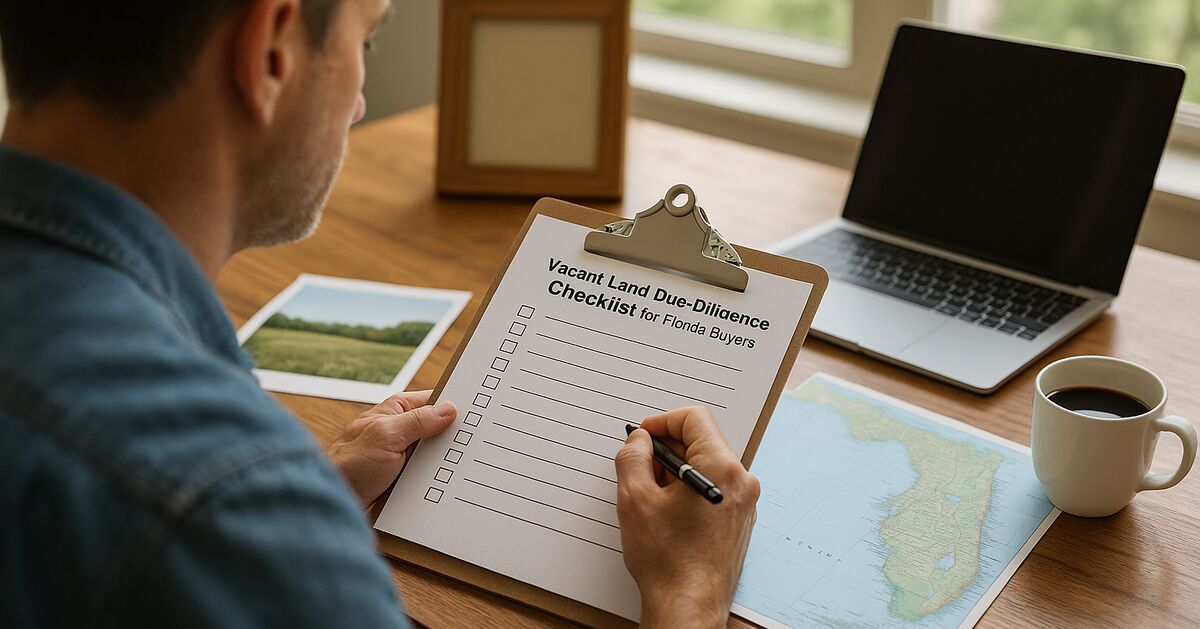
Vacant land is the one kind of real estate where nobody makes you do your homework. There is no lender ordering an appraisal, no inspector poking at the roof, and often no agent. That is part of why it is cheap, and it is all of why some buyers get burned. This checklist is what we would do before paying anyone for a vacant Florida parcel, including us. It takes an evening, most of it is free, and it uses records every Florida county publishes online.
Work through it in order. Each step either confirms the listing or turns up a question to ask before you pay.
1. Pull the parcel on the county Property Appraiser site
Every Florida county has a Property Appraiser with a public website. Search by the parcel number from the listing (ours are on every listing on the available land page). What you are looking for:
- Owner of record. It should match the seller. For our parcels it will say Lotvestors LLC. If it does not match, stop.
- Acreage and legal description. Compare with the listing. Small differences in acreage between a plat and the appraiser's calculation are normal; a big difference is not.
- Assessed and market value. The county's number is not a sale price, but it tells you whether the asking price is in the neighborhood of what the county thinks.
- Aerial photo and GIS map. Most counties let you see the parcel outline over a satellite image. This is the single most useful thing you will look at. Is it pine scrub? Standing water? Is there a road touching it, or is it in the middle of a grid of trails?
- Sales history. How much did it last sell for, and when? A parcel that changed hands recently at a very different price is worth a question.
If a seller cannot or will not give you a parcel number, that is the end of your due diligence and the end of the deal.
2. Call the county Planning and Zoning office
This is the call that most buyers skip and every buyer should make. Give them the parcel number and ask:
- What is the zoning and future land use designation?
- Could a building permit for a single-family home be issued on this parcel today? If not, why not?
- Is there a minimum lot size for a septic system or a well?
- Are there any overlays, conservation designations or development restrictions?
- Is there a constructed, county-maintained road to the parcel?
Write down the answers and the name of the person you spoke with. On our investment acreage the answer to the permit question will almost always be no, which is exactly why those parcels are priced the way they are and sold for buy-and-hold. Hearing it from the county rather than from us is the point.
3. Check the flood map
Go to the FEMA Flood Map Service Center and enter the parcel's address or GPS coordinates. You will get a flood zone designation. Zones beginning with A or V are high-risk; X is minimal. A lot of central Florida is in a flood zone or close to one. For a buy-and-hold investment this may not change your decision. For any future building it will affect what can be built, how high, and what insurance costs.
4. Check for wetlands
Wetlands are a separate question from flood zones. Look at the parcel on the county GIS map with any wetland or conservation layer turned on, and check the National Wetlands Inventory mapper. If the aerial shows dark, saturated ground or cypress, assume wetlands until proven otherwise. Wetlands can make part or all of a parcel undevelopable regardless of zoning. We tell you what we know about each parcel, but we have not walked most of them and we are not surveyors, so this is one for you.
5. Verify physical access
Look at the aerial again and trace a route from a public paved road to the parcel. Is there a maintained road? A graded dirt road? A sand trail? Nothing? Then confirm with the county whether any road touching the parcel is public and maintained. Many cheap parcels in old platted subdivisions have no physical access at all. On our listings we state what we know, and where a parcel has no access we say so and recommend you do not try to visit. Do not assume you can drive to a parcel because a line on a map has a street name.
6. Understand the easements
Legal access and physical access are different things. In an unbuilt subdivision, the developer recorded a plat with rights of way, often 25 or 30 feet wide, between the lots. Those easements are what our listings mean by road access: easements. They guarantee that the parcel is not landlocked in the legal sense and that a road could be built along them someday. They do not mean a road exists. Also check the plat and the deed for other easements: utility easements, drainage easements, or access easements that cross the parcel for someone else's benefit. The county Clerk of Court's official records and the recorded plat will show them.
7. Check taxes
The county Tax Collector site shows current and delinquent taxes. Confirm that taxes are paid up. Note the annual amount; on our investment acreage it is usually tiny, and we show it on the listing. If you buy with owner financing from us, we pay the annual tax bill while the parcel is in our name and invoice you for it, as explained on the owner financing page. After payoff, the bill comes to you. Also check whether any tax certificates have been sold on the parcel, which happens when taxes go unpaid and can lead to a tax deed sale.
8. Search for liens, judgments and code violations
The Clerk of Court's official records search will show mortgages, liens and judgments recorded against the parcel or its owner. Then check the county code enforcement office for open violations: dumping, unpermitted structures, overgrowth citations. Code liens run with the land, so a violation from a previous owner can become your problem. On a parcel nobody can drive to, this is rarely an issue, but it costs nothing to look.
9. Ask about an HOA or a property owners' association
Old investment subdivisions usually have none, and our listings show HOA: None where that is the case. Newer subdivisions and some older ones do have an association, with dues, deed restrictions and sometimes architectural rules. Check the recorded plat and the deed restrictions in the Clerk's records, and ask the seller directly.
10. Decide whether you need a survey
For a buy-and-hold parcel you may not visit for years, most buyers skip the survey and rely on the county GIS outline, and that is a reasonable choice for the money involved. If you ever intend to build, fence, or clear, get a boundary survey first. A survey also finds encroachments, such as a neighbor's fence or shed on your lot. We do not provide surveys, and we sell as-is.
11. Read the contract terms
If you are buying with owner financing, read the contract before you pay, not after. For ours, the substance is on the owner financing page and the terms page: $99 down, $199 document fee, 16% interest, no prepayment penalty, first payment on the 15th of the next month, a $35 or 15% late fee, a ten-day cure period on default, and six use restrictions during the contract. All payments are non-refundable. If you want the actual document, ask on the contact page and we will send a sample.
12. What to ask us
We answer questions before a sale gladly, and we would rather you ask than guess. Useful ones:
- Have you personally visited this parcel? (Often the answer is no, and we will say so.)
- Are the listing photos of the parcel itself or representative of the area?
- Is there anything you know about access, wetlands or flood zone beyond what the listing says?
- Do you have adjoining lots or similar inventory not yet listed?
- Can I see a sample Contract for Deed?
- What is the current payoff process if I want to pay early?
Call Customer Service at contact form or use the contact page. The FAQ covers most of the process questions.
13. Keep a file
Whatever you find, keep it. Save a screenshot of the Property Appraiser record and the aerial on the day you looked. Write down the date, the office and the name of the person you spoke with at Planning and Zoning, and what they said. Save the FEMA map printout. Keep the signed contract, every payment confirmation, and every annual tax invoice in the same folder. On a parcel you may hold for ten years, that file is the difference between knowing what you own and guessing. It is also what a future buyer, or your heirs, will want to see first.
A word about what the checklist cannot do
Due diligence tells you what a parcel is today. It cannot tell you what it will be worth in ten years, whether the area around it will develop, or whether a road will ever be built. Land can lose value. Not buildable at this time may mean not buildable for a very long time. A parcel with no physical access may never get any. Our opinions about future value are opinions, offered as a courtesy, and nothing is guaranteed. Everything we sell is sold as-is, and every payment is non-refundable. The checklist reduces surprises. It does not remove risk, and anyone who tells you otherwise is not doing you a favor.
The short version
Look up the parcel number. Call Planning and Zoning. Check FEMA and wetlands. Trace the access. Read the easements. Confirm taxes and liens. Ask about an HOA. Decide on a survey. Read the contract. Then, and only then, pay the $298 to reserve. That order has kept our buyers out of trouble for years, and it works just as well for land you buy from anyone else.
Questions
Questions about a parcel?
Tell us which parcel you are looking at and what you want to know. A real person at Lotvestors LLC answers by email, usually within one business day.
We work by email, not by phone: it keeps a written record of every answer about a parcel.