Polk County's Path of Growth: Land Along the I-4 Corridor Between Tampa and Orlando
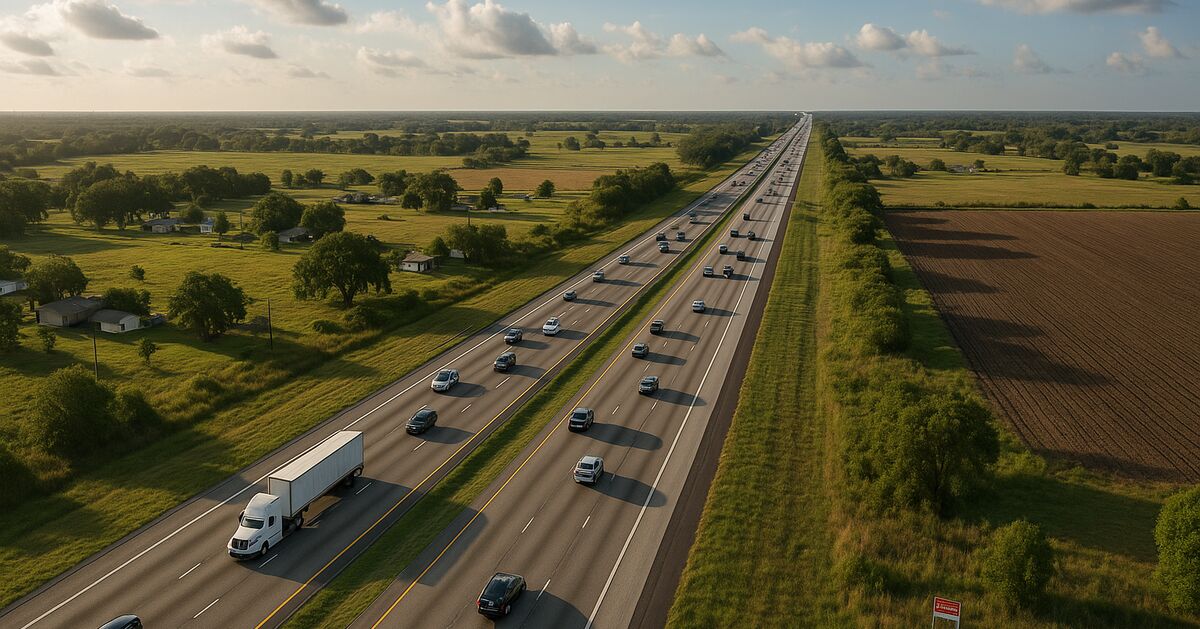
Most of the land we sell is in Polk County, and most of that is within a few miles of Interstate 4. That is not an accident. This post explains what the I-4 corridor is, what the land around Polk City actually looks like, why the old platted subdivisions there are the core of our Investment Acreage Program, and why buy-and-hold buyers keep coming back to it. Then, because we would rather you buy with your eyes open, it makes the case against.
The geography in one paragraph
I-4 runs diagonally across the Florida peninsula from Tampa on the Gulf coast to Daytona Beach on the Atlantic, and it passes through Orlando on the way. The stretch between Tampa and Orlando is a little over 80 miles, and Polk County sits in the middle of it. Lakeland is the big Polk County city on the corridor. Polk City is a small town just north of I-4 near where US 27 (also signed as State Road 25) crosses the interstate. That I-4 and US 27 interchange is the critical commercial junction of the corridor: US 27 runs north toward Clermont and Ocala and south toward Lake Wales and Sebring, and it is the road trucks use to get from I-4 to the rest of the state. Land near that interchange is where our story starts.
What is actually there
Two kinds of things.
First, logistics. Near the I-4 and US 27 interchange, off Old Grade Road, there is a Walmart distribution center, an Amazon fulfillment center, a FedEx facility, and a growing collection of other large commercial operations. They are there for the obvious reason: a truck leaving that interchange can reach Tampa or Orlando in about an hour and most of the state's population the same day. Distribution centers want cheap land next to a highway between two big cities, and this is that.
Second, paper subdivisions. Around Polk City and along the corridor there are several subdivisions that were platted decades ago and never built. The names you will see on our available land page and on the county records include Orlando Pines (Units 1 through 4), Valhalla Acres, Gateway Acres, Forest Hills Acres and Groveland Ranch Acres. A developer drew lot lines, recorded the plat, and sold one-acre and multi-acre lots to buyers around the country. The roads were never constructed. What exists today is a grid of 25 or 30 foot wide platted rights of way on paper, sand trails and pine scrub on the ground, and hundreds of individually owned lots with very low property taxes.
Those lots are what we buy from the original owners and their heirs, and what we resell as buy-and-hold investment acreage.
What a typical listing on the corridor looks like
An example from our own inventory: two adjoining one-acre lots in Unit 2 of Orlando Pines, near the I-4 and US 27 interchange and just off Old Grade Road. Two acres total, cash price $6,999, or $99 down and $167.79 a month for five years with owner financing. No constructed road, no power, water would be by well and sewer by septic if that were ever permitted, and it is not buildable at this time. The listing says so in those words. It sits within a few miles of the Walmart and Amazon distribution centers, which is the entire reason it is priced at $6,999 rather than $2,999 and the entire reason someone would buy it.
A larger example: Tract 133 in Valhalla Acres, 4.47 acres, cash price $11,399 or $198.03 a month for nine years, annual taxes of $29.31, road access by platted easements, no utilities. There are trails through the area, but getting to the tract today would be difficult at best, and the listing says that too.
That is the pattern. A real parcel number, real GPS coordinates, a real (and small) tax bill, honest access and utility information, and a price that reflects a location rather than a use.
Why buy-and-hold buyers like it
We can only give you our opinion here, and we will label it as such. Here is the case as our buyers see it.
- It is between two large metros. Growth does not have to reach Polk City from one direction. It is pushing in from Tampa and Lakeland on the west and from Orlando and the theme-park economy on the east. Land in the middle of two growing cities is a different bet from land at the end of a road.
- The commercial anchors are already built. The distribution centers near I-4 and US 27 are not a proposal. They exist, they employ people, and they attract suppliers, truck services, fuel, and housing for the people who work there.
- The entry price is very low. One-acre lots in Orlando Pines have listed on our site for as little as $2,999 cash; larger tracts like 4.47 acres in Valhalla Acres for $11,399. With owner financing that is $99 down and a fixed monthly payment.
- The carrying cost is almost nothing. Annual property taxes on these lots run from single digits to a few dozen dollars. A ten-lot package we sold carried a combined tax bill of $65.50 a year. There is no HOA. You can hold for a very long time without the holding cost eating the position.
- The likely exit is assemblage, not a house. Our honest view is that these subdivisions will probably never become neighborhoods of homes. A more plausible scenario is that a developer or an industrial user eventually wants the whole area for commercial or logistics use and offers to buy out the individual lot owners. That is what has happened elsewhere on the corridor. It is our opinion, not a prediction we can back with a date.
Put together: cheap to buy, cheap to hold, sitting between two growing cities next to an interchange that logistics companies have already chosen. That is why we call it the path of growth, and why we wrote Land banking in Florida and Is this useless land? largely with this corridor in mind.
The case against
Now the other side, because it is real.
- Paper subdivisions can stay paper forever. Orlando Pines has been unbuilt for decades. Nothing forces it to change. Florida is full of platted lots that have been waiting since the 1960s and will still be waiting in 2060.
- No physical access. Most of these lots cannot be driven to. The easements guarantee legal access, which matters for a future buyer, but you cannot use the land today and we tell buyers not to try to visit some of them.
- Not buildable, and maybe never. No roads, no power, no water, no sewer. The county is not going to issue a building permit on a lot with no constructed road, and building the road is a subdivision-scale project, not a landowner-scale one.
- Wetlands and flood zones. A lot of this corridor is low and wet. Some lots are in mapped flood zones or contain wetlands that would restrict development even if everything else lined up. Check the FEMA map and the county for any specific parcel.
- Assemblage may never come, or may come cheap. Even if a developer wants the area, buying out hundreds of scattered owners is slow and expensive, and the price offered may not be what you hoped. Some assemblages never happen because too many owners cannot be found.
- It is illiquid. There is no quick way to sell a lot like this. The market is thin, mostly other investors, and a sale can take a long time. Do not buy with money you might need back.
- Interest is a real cost. If you finance at 16% over several years, the land has to appreciate meaningfully just to cover what you paid in interest. Cash buyers do not have that hurdle.
- We are selling it. We own these lots and we make money when you buy them. Weigh our opinion accordingly, and check everything we say against the county records.
How long is long?
Buy-and-hold means what it says. Nobody should buy a lot in Orlando Pines expecting to resell it at a profit in two years; the market for individual lots is thin and the interest on a financed purchase alone would eat a modest gain. The buyers who make sense here think in terms of a decade or more. They pay it off, they pay the tiny tax bill every year, and they wait for the corridor to do whatever it is going to do. Some of them are buying for their kids. That is a legitimate way to own a hard asset, and it is also a long time for money to be tied up. Be honest with yourself about which one you are describing.
What we can and cannot tell you
For every parcel we list, we tell you the parcel number, the GPS coordinates, the acreage, the annual taxes, what we know about road access, that there are no utilities, and that it is not buildable at this time. We tell you the subdivision name so you can look at the plat. We do not tell you what it will be worth, when the area will develop, or whether anyone will ever want to buy you out, because we do not know. Opinions of future value are given as a courtesy and nothing is guaranteed. Every parcel is sold as-is.
If you want to verify a Polk County parcel yourself, the county Property Appraiser website will show you the ownership, the aerial, and the plat. The county Planning and Zoning office will tell you the zoning and whether a permit is possible. The FEMA Flood Map Service Center will show you the flood zone. Those three sources will teach you more in an hour than any listing can, ours included.
Who this corridor is right for
Someone who wants a low-cost, low-carry hard asset between two growing cities, who can hold it for a long time, who accepts that it may never be buildable and may never be worth dramatically more, and who would still rather own an acre of Florida than the same money in a savings account. If that is you, browse the Polk County parcels on the available land page, read the FAQ, and use the contact form if you have a question we have not answered. If you want land to use this year, this is not the corridor, and we would rather tell you now.
Questions
Questions about a parcel?
Tell us which parcel you are looking at and what you want to know. A real person at Lotvestors LLC answers by email, usually within one business day.
We work by email, not by phone: it keeps a written record of every answer about a parcel.